


What Goes Into the Ground Under Your Concrete?
Updated: Sep 8
Traditional mudjacking places a soil or topsoil mixture under the slab. Cement slurry places cement, aggregates and water, which cure to an inert mineral solid. Polyurethane foam is made by mixing two reactive chemical components on the property, an isocyanate side and a polyol side, which cure to a plastic.
Why does the material matter?
When choosing a method to raise settled concrete, homeowners also consider what is being introduced onto their property. The materials differ significantly in composition and on-site impact.
What does traditional mudjacking put under the slab?
Uses a mixture of soil, topsoil, or “mud,” sometimes with only a small amount of cement.
Material quality and strength are highly variable.
Once in place, the mix can shrink as moisture leaves and is more susceptible to future erosion or washout.
No reactive industrial chemicals are mixed on site, but the long-term stability of the fill is lower than a properly engineered cement slurry.
Essentially places a soil-based material under the slab that may not remain as durable over time.
What does cement slurry put under the slab?
Made from cement, aggregates, and water, mineral-based materials commonly used in construction.
No reactive chemical components such as isocyanates are mixed or injected on the property.
Once cured, the material is inert, stable, and does not off-gas.
The primary environmental footprint comes from cement manufacturing (which produces CO₂), the same as any other concrete work.
No risk of chemical spills involving sensitizing agents during the injection process.
What does polyurethane foam put under the slab?
Created by mixing two liquid chemical components (typically an isocyanate side and a polyol side) on site.
Isocyanates are known respiratory sensitizers. Proper protective equipment and handling are required during application to avoid exposure to fumes or uncured material.
The cured foam is a plastic/polymer material that is not biodegradable.
While modern lifting foams are formulated to be stable once cured, the mixing and injection process involves handling reactive industrial chemicals on the homeowner’s property.
Spills of uncured components require careful cleanup.

A-Side(ISO) | B-Side(resin) |
|---|---|
isocyanate component mixed on site | Polyol component mixed with A side the job to make a lifting foam |
How do the three materials compare on the property?
Aspect | Traditional Mudjacking | Cement Slurry Raising | Polyurethane Foam |
|---|---|---|---|
Base materials | Soil / topsoil ± limited cement | Cement, aggregates, water (mineral-based) | Two-part reactive chemicals (isocyanate + polyol) |
On-site chemical reactivity | None | None | Yes – components react during and after injection |
Potential airborne exposure during work | Minimal | Minimal (mainly dust from mixing) | Possible isocyanate exposure fumes if not properly controlled1 |
Potential interaction with soil | None | None | Uncured material is reactive; cured foam is generally stable2 |
Cured material character | Variable soil-cement mix | Inert cementitious solid | Plastic/polymer foam |
Biodegradability | Lower – can shrink or erode | Not biodegradable, but mineral-based | Not biodegradable |
Pest interaction | Variable | Hardened cement slurry is a mineral material, so it is neither a food source nor a habitat for pests | Pests such as termites and rodents can tunnel through3 |
Long-term stability on property | Soil-based | Highly stable once cured | Stable when properly installed, but remains a polymer |
Approx. CO₂ per Cubic Yard of Material7 | ~0 lb When (0 cement added)4 | 280 lb CO₂/yd³ material5 | ≈ 175-281 lb CO₂/yd³ material6 |

Can the material escape onto siding, doors or trim?
The three concrete-raising methods create lift in different ways, and those differences affect the risk that material will escape onto visible surfaces.
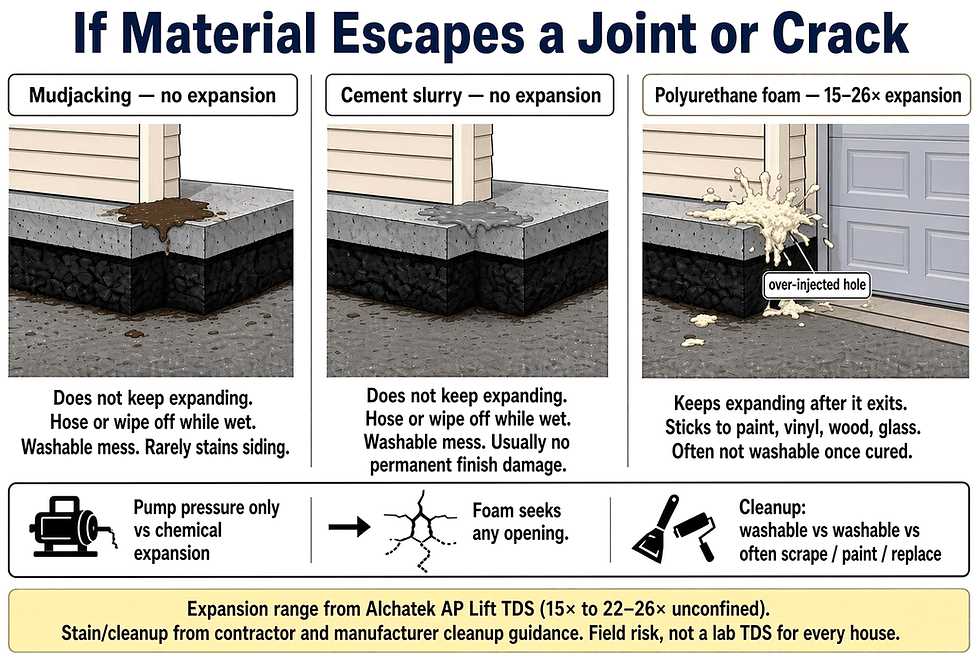
Traditional mudjacking and cement slurry rely only on hydraulic pump pressure. There is no chemical expansion. Material is pushed into voids and then builds pressure to raise the slab. If leakage occurs through a crack or joint, the escaped material is a non-expanding slurry or soil mix. It is usually messy but can often be cleaned while still wet and rarely causes permanent staining on siding, doors, or painted surfaces.
Polyurethane foam works by chemical expansion. The liquid components react and expand rapidly (typically 15–26 times their original volume), generating the lifting pressure. Once the reaction begins, the foam will seek any available exit path. If there is a gap between a garage slab and driveway, a joint against the house, or a crack leading to the exterior, the expanding foam can force its way out.
When foam escapes, it continues to expand and can stick to wood, painted surfaces, vinyl siding, and glass or even concrete surfaces. Field examples from contractor discussions show foam exiting onto garage doors, house siding, and patio-door frames, leaving yellow or white residue that is difficult or impossible to remove. In some cases, the damage requires painting or replacement of the affected surface.
Practical takeaway
Slurry and traditional mudjacking can leak, but the material does not keep expanding after it leaves the void. Foam’s ongoing expansion increases both the chance of escape and the difficulty of cleaning the resulting stains on doors, siding, and trim. This is a documented real-world trade-off of expansion-based lifting.
The side-by-side table of expansion, escape risk and cleanup difficulty for all three methods sits on the concrete leveling methods comparison.
What is the practical takeaway on materials for homeowners?
Traditional mudjacking places a variable soil-based mix under the slab. Cement slurry uses familiar construction materials that harden into a strong, inert solid. Foam requires the on-site handling and reaction of industrial chemical components. For property owners who prefer a durable, non-reactive, cement-based support material, engineered cement slurry offers the most conventional and stable profile of the three options.
Frequently asked questions about concrete lifting materials
Is polyurethane concrete lifting foam safe?
Isocyanates are known respiratory sensitizers. Proper protective equipment and handling are required during application to avoid exposure to fumes or uncured material. That risk applies to uncured components during mixing and injection. Cured foam under a slab is a different material.
Does cement slurry off-gas or use reactive chemicals?
No reactive chemical components such as isocyanates are mixed or injected on the property. Once cured, the material is inert, stable, and does not off-gas.
Can lifting material leak out and stain siding or a garage door?
When foam escapes, it continues to expand and can stick to wood, painted surfaces, vinyl siding, and glass or even concrete surfaces. Field examples from contractor discussions show foam exiting onto garage doors, house siding, and patio-door frames, leaving yellow or white residue that is difficult or impossible to remove. In some cases, the damage requires painting or replacement of the affected surface.
Which method leaves the most stable material on the property?
For property owners who prefer a durable, non-reactive, cement-based support material, engineered cement slurry offers the most conventional and stable profile of the three options.
What to read next
What each material becomes once it has cured, and how much load it then carries, is set out on what holds up your slab after it is raised. The full three-way comparison of cement slurry, polyurethane foam and traditional mudjacking is on the concrete leveling methods comparison.
To have the actual conditions under your concrete assessed, contact SAVE Concrete for a professional evaluation of the driveway, patio, stoop or sidewalk in question.
References on this page
archive.epa.gov/epa/saferchoice/potential-chemical-exposures-spray-polyurethane-foam.html
A. Jukna “Diisocyanate exposure to soil and persistence of reaction products”
clemson.edu/public/regulatory/pesticide-regulation/bulletins/bulletin-9-foam-insulation.pdf
Mudjacking mix composition varies and most of the time no cement added, if cement added then it would be more than zero.
U.S. EPA Cement Industry Carbon Intensities Fact Sheet (≈ 0.8 t CO₂ per ton of cement). Supporting industry analyses (Clean Air Task Force / related EPA GHGRP data).
ISOPA / Plastics Europe Eco-profiles (MDI ≈ 2.76 kg CO₂e/kg cradle-to-gate).
These are approximate material-level calculations, not complete life-cycle assessments. The comparison depends on assumed material density, cement content, chemical formulation, transportation, and system boundaries.


Comments